The lump sum is on the desk already
No other retail counter has the customer's full attention at the moment they learn what they are receiving.
Tax preparation is the one appointment where a customer sits down, sees a number, and decides what to do with it. Adding crypto to that conversation is the most natural product placement in retail finance.

$1,200.00
Bitcoin · out of a refund, in the office
A tax office's client arrives with a specific question — how much am I getting — and leaves having made a decision about it. For many clients that lump sum is the biggest amount of money they will handle all year. The decision about where it goes is made in your office, at your desk, in the ten minutes after the number appears.
Today that decision is between cash, a prepaid card and a bank deposit. Some clients are already putting part of it into crypto — they are just doing it afterwards, somewhere else, usually at a machine.
Because crypto revenue is a percentage of the order and refund-season orders are large, a tax office can generate meaningful revenue from a small number of clients in a short window. The seasonality that makes tax preparation hard works in your favour here.
Why it fits
Every store type in this program runs the same platform. What changes is the customer, the ticket size and the objection — so this is the part written for you rather than for everybody.
No other retail counter has the customer's full attention at the moment they learn what they are receiving.
Refund-driven orders are among the largest in retail crypto, and they arrive in the months you are already fully staffed.
No equipment, no monthly fee and no minimum, so a quiet summer costs your office nothing.
You are already looking at documents and confirming identity. The verification step is not a new imposition on the client.

Getting started
Where the store is, what it already offers, and what your foot traffic looks like. We tell you straight away whether we can serve your market.
Entity documents, ownership and any licences your store already holds. Days, not months.
One session per employee. No crypto knowledge required — the order screen is shorter than a money order form.
Logins switched on, revenue share accruing on every order your staff place.
The arithmetic
You keep a share of every order. Bigger order, bigger share. The examples below use 1% to 3% — your own rate is in your agreement.
| At the counter | Order size | Store keeps (low) | Store keeps (high) |
|---|---|---|---|
| A customer cashes a check and puts part of it into Bitcoin | $200 | $2.00 | $6.00 |
| A regular buys USDT to send to family overseas | $500 | $5.00 | $15.00 |
| A customer sells crypto and takes the cash | $1,000 | $10.00 | $30.00 |
| A small business owner buys on payday, every other week | $2,500 | $25.00 | $75.00 |
| One larger order, the kind an ATM's daily cap refuses | $10,000 | $100.00 | $300.00 |
The figures above are worked examples, not projected or guaranteed earnings. They show how the arithmetic works on a given order size at an illustrative revenue-share range. Your actual rate is set in your agent agreement, and what any individual store earns depends on its foot traffic, its neighbourhood, its hours and how many customers it serves. Anytime Capital does not promise any level of income.
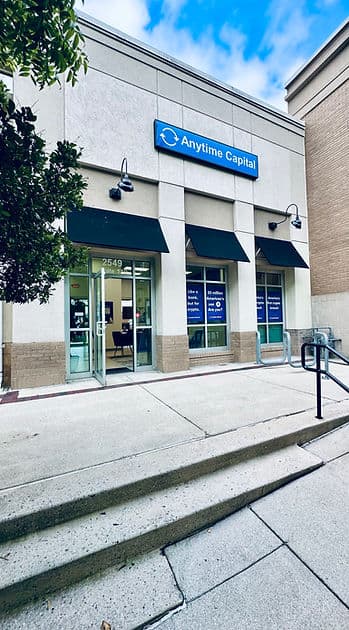

Anytime Capital runs its own branches in Atlanta and Miami. Partner stores run the same counter service.
This one matters more in a tax office than anywhere else in the program, because your client is sitting across a desk from someone they consider a financial professional. The rule in the training is unambiguous: staff serve the transaction, they do not recommend it. Nobody in your office should be telling a client that buying crypto is a good idea.
What staff can do is answer the question when the client asks it, explain what the price is, and place the order the client has decided to make. That is the same boundary your office already keeps around every other product it does not advise on.
Anyone in a tax practice should also be clear with clients that the tax treatment of a crypto purchase is the client's business to understand — and that is a conversation your office is unusually well placed to have honestly.
Tax offices run on a compressed revenue window and a fixed cost base. Anything that raises revenue per client during the season without raising the cost base is disproportionately valuable, and this product has no cost base at all.
The practical approach most offices take is to mention it once, at the point the refund figure is agreed, and let the client raise it if they are interested. Pushed harder than that it feels like a sale; offered once it feels like a service.
Clients who buy in one season usually come back the next. Many come back between seasons too. That is how an office closed half the year builds a year-round reason for clients to walk in.
Keep reading
The numbers, the rules and the alternative you have probably been offered.
No, and the training is explicit about it. Staff serve the transaction the client has decided to make. They do not recommend crypto or advise on it, exactly as they would not for any other product the office does not advise on.
Anytime Capital carries the recordkeeping and regulatory reporting that attaches to the crypto activity. Your client's own tax position on their purchase is theirs, and your professional obligations to your client are unchanged.
There is no equipment cost, no monthly fee and no minimum, so an off-season costs nothing. The refund-season orders are large enough that a small number of clients can make the product worthwhile.
Not one of your own to act as a location for Anytime Capital's platform. What applies to your state and business type is confirmed during onboarding, and nothing here is legal advice.
Not to act as a serving location for Anytime Capital's platform. Anytime Capital is the registered money services business and carries the compliance programme for the activity. What applies to your specific store and state is confirmed during onboarding, and nothing here is legal advice.
A share of each order, set in your agent agreement. Because crypto is priced as a percentage of the order rather than a flat fee, the revenue moves with the ticket. The earnings page works the arithmetic through at five order sizes.
Tell us where the store is and what your customers keep asking for. We will tell you what we can offer at your location.